
Written by David Johnson
Photographed by Jerry Monkman - EcoPhotography and David Johnson
All creatures great and small are welcome at the Keim Conservation Easement.
When you walk onto Cheryl Keim’s Hampstead property, you’re setting foot into a hand‑drawn animated Disney movie.
The relative silence of the easygoing, small‑town neighborhood gives way to a symphony of cooing, skittering, chittering, and chattering. It genuinely feels like at any moment a two‑dimensional pastel songbird will land on your shoulder and warble a tune about house chores. That is pretty much the feeling Cheryl is going for.
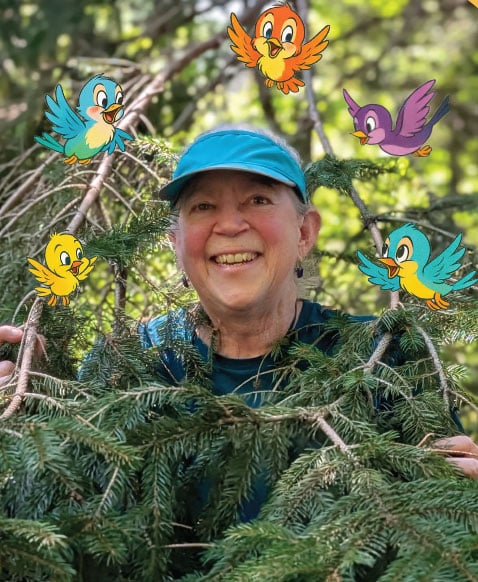 Through patient property acquisition, careful land management practices, curated gardening endeavors, and an abiding love for all manner of creeping, crawling, clambering, or cruising critters, her love for the natural world and its inhabitants shines through. That’s how it’s been since she moved into her home in 1987 with Tom, her then‑husband (and current friend and partner in property stewardship).
And that’s what it’s been like since—the welcome mat is always rolled out for all creatures great and small. Conservation was always going to be the ultimate destination for this land. Cheryl felt so compelled to ensure her friendly neighborhood biosphere remained undeveloped that she decided to work with SELT and, generously, donate a conservation easement. It is easy to understand such passion when you realize a love for conservation is in her DNA.
“I was a nerdy little kid that read encyclopedias,” Cheryl says. “Anything that I could learn about nature, I soaked in. That was my thing.”
When she was eight years old, Cheryl would routinely accompany her grandfather, a game warden, on his patrols. Nothing was better than getting outside and seeing her reading material spring to life. One of her main tasks was to retrieve felled groundhogs that her grandfather picked off for farmers, who were concerned that their livestock would break their legs putting hooves down into burrows. Less than glamorous work, sure, but it was honest, and it was a passport to the outdoors, the object of her rapidly developing love.
The family ties don’t stop there; Cheryl’s mother was one of the founding members of the Wildlands Conservancy in Pennsylvania and became a force for conservation in her own right. Fast‑forward to Cheryl’s life as a landowner, and that love of the outdoors manifested itself in a new way: the patient and opportunistic accumulation of beautiful land with high‑end natural resource value. Throughout the years, Cheryl and Tom methodically pieced together a series of parcels abutting their property, steadily growing a forested tapestry.
“This way, the land stays as a forest,” she says. “Instead of buying a place on a lake somewhere, we have this.”
That’s how a 2.6‑acre house lot transformed into a full‑scale 35+ acre wildlife preserve; and why conserving it with SELT became the manifestation of her life’s legacy.
“Instead of buying a place on a lake somewhere, we have this.”
“We intentionally kept it natural and undeveloped,” she says. “Tom and I both grew up watching forests and fields being paved over. There was one place in Pennsylvania that I loved to explore as a child, and one day, when I was 14, all I could see were big machines. The trees were gone. I just burst into tears.”
To articulate the full wildlife inventory on this land would take a whole afternoon. Off the top of her head, Cheryl reels off the species that traipse between her boundaries: deer, turtles, spotted salamanders, yellow‑garter snakes, wood ducks and mallards (who use a “duckway” to travel to the beaver pond and back), muskrats, otters, opossums, bobcat, gray foxes, red foxes, fishers, and birds too numerous to list. Safeguarding her critter‑cosmos became a paramount priority, especially when a medical scare prompted her to put some serious thought into pursuing conservation.
"'What do we do?’” Cheryl recalled the question she and Tom asked themselves. “‘How do we keep it from being built on and the trees getting cut, and all the animals going away?’ You get to a point with age where you start thinking about these things.”
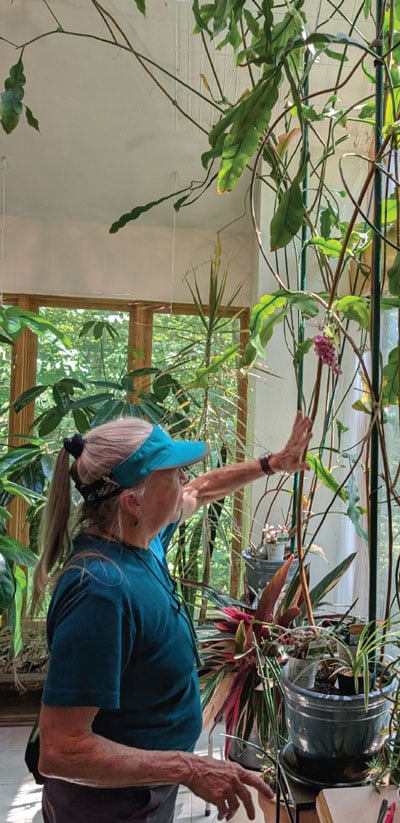 When these discussions began to percolate, she was relatively unfamiliar with SELT. But word of mouth (and her notice of more and more SELT signs popping up on nearby conserved lands) led her to make a fateful inquiry: would SELT be interested in conserving her beloved property? And to further showcase her commitment to seeing this through—she opted to generously donate the conservation easement, a gift worth over $121,000 in market value.
“We are deeply grateful for Cheryl's remarkable generosity in pledging to donate this conservation easement,” says Kaitlin Deyo, Conservation Project Manager for SELT. “This exceptional property serves as a vital wildlife corridor that ensures passage for a variety of species, protects clean drinking water, and connects seamlessly with a broader network of conserved lands. We're honored to bring Cheryl's long‑held vision to conserve this land to fruition.”
The protection of these 35 acres represents a fulcrum point in the community’s conservation canvas; the “Keim Forest Conservation Easement” abuts the 137‑acre Kingston Town Forest (another easement held by SELT), and that in turn connects to the 118‑acre Mount Misery property, owned by the Town of Plaistow. And that’s not all. Across Mount Misery sits the 405‑acre Plaistow Town Forest (yet another easement held by SELT). All of this contiguous, conserved land is cradled within a 1,710‑acre block of unfragmented forests. Though the Keim Easement may be small in comparison, its role as a connector is mighty.
“This large, contiguous swath of conserved and public lands is uncommon for this highly developed part of the region,” says Kaitlin. “When you step back and look at the breadth of nearby conservation, protecting the Keim Forest becomes a critical priority. It represents a keystone piece in an area that is white‑hot for development.”
For Cheryl, the proposition is simpler: her land will provide a linkage to a cohesive, diverse, enduring habitat for all creatures great and small.
“They're my neighbors,” she says. “They're my family.”