
Daydreaming Out Loud
Written by David Johnson
Photographed by Sherri Nixon and David Johnson
How the cross-country, agricultural vision of two independent organic farmers became a reality.
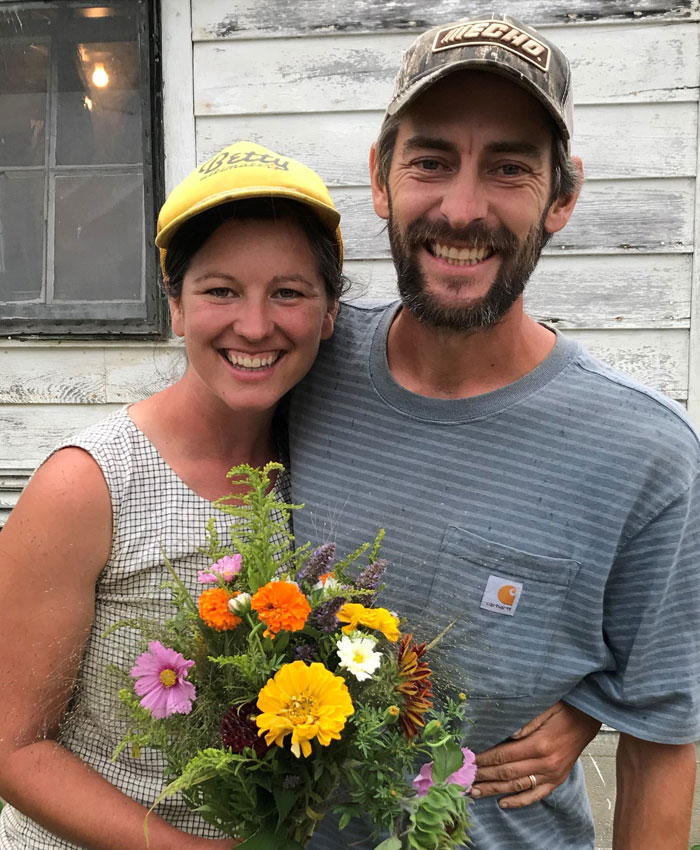 The moment you set foot onto Clyde Farm, there’s an excellent chance the farm’s namesake will bound up to you, tail wagging and tongue lolling, eager to welcome you to his stomping grounds. Clyde the dog is happy you're here! Also happy you’re here are Jimi Tutor and Kristen Klenow, Clyde’s owners and the owners of Clyde Farm, a small organic food and flower‑producing operation in Farmington, NH.
Jimi and Kristen have carved out a solid foothold in the local organic farming scene, providing fresh‑cut vegetables and flowers, as well as organic eggs, chickens, and lamb. Kristen handles the plant and veggie side of things, all of which are USDA Certified Organic, grown in their own potting soil and compost made from used bedding from their livestock.
Speaking of livestock, Clyde Farm’s animal production—Jimi's focus—is also Certified Organic. The chicken broilers, a calling card of Clyde’s, are raised in mobile pods that are moved daily to give the chickens fresh pasture to cycle through. This results in healthy poultry that enjoy fresh air and green grass, healthy soil enriched by a steady supply of chicken manure, and all‑around efficient energy consumption. The farm‑roaming chickens also stockpile protein and vitamins through their outdoor activity, lending a hearty taste to the meat.
While Clyde Farm has been embraced by the community and Jimi and Kristen are finding success as independent farmers, the road to Clyde Farm—and a pathway to ownership (more on that later)—was a winding journey. Originally from California, Jimi and Kristen entered agriculture through different avenues: for Jimi, through a winery owned by friends; for Kristen, as a vegetable farmer in Sonoma. They left the West Coast in search of a strong local food scene and affordable land—a new beginning. So they jumped into their camper van and headed east.
They didn’t have a firm destination in mind. If the right opportunity presented itself, they would have stopped in any state they drove through. But they continued onward—Jimi, Kristen, and Clyde—breaking up long days of driving by wish‑casting what their future farm might look like.
Eventually the camper van reached the end of the contiguous 48, stopping in New Hampshire. Anchored by a friendship base and compelled by the landscape and traditions that make the Granite State an agricultural nirvana, the trio began their farming vision quest by attaching themselves to already‑established farms, learning, growing, and making a name for themselves.
“That was a really good place to start,” said Kristen. “I had been farming for a long time but never in this climate, so I learned a lot in those first few years.”
As their expertise grew, so did their need for bigger and richer farmland. They began leasing farmland, and while that was rewarding and financially necessary, the dream of putting down roots and investing long‑term required ownership.
“Owning land rather than leasing land opens up many more options,” says Jimi. “Planting orchards or putting in grapevines—you would never invest in building something like that on leased land.”
That dream inched toward reality when SELT connected Jimi and Kristen to the Carlsen family in Farmington, who had operated a dairy farm for decades before winding it down thirty years ago. The fields sat unused, ready for their next caretakers—until 2019.
Everett and Shirley Carlsen wanted to see the farm conserved and protected from development. For them, it was important that it be passed on to the next generation of farmers.
“Owning land rather than leasing land opens up many more options,” says Jimi. “Planting orchards or putting in grapevines—you would never invest in building something like that on leased land.”
Through SELT, Jimi and Kristen came to an agreement with the Carlsen family to lease the land and set up Clyde Farm, with the end goal of purchasing it. SELT is currently working to place a conservation easement on the property while Jimi and Kristen lease the farm until the easement is in place. Then they will buy the property from the Carlsens at a value reflecting that the land is now conserved.
“We really found a good niche here,” Kristen says. “There really seems to be a need for local, organic produce. And now that we’re going to own this place, we’ve planted a bunch of perennials—apples, berries, tons of flowers I would have never been able to grow.”
“People ask us, ‘How did you find this place?’” Jimi says. “This seems like such a match made in heaven. We just reached out to SELT like a lot of farmers do and daydreamed out loud to them about what we were looking for in an ideal farm property. And they let us know when something came up that fit those parameters. Having SELT as the match‑maker has allowed this deal to happen at ‘farmer speed’ rather than having to compete on the open market for property.”
SELT is grateful for the patience and support of the Carlsen family as they explored options with SELT, and for the generosity of the William H. Donner Foundation, the NH Farm Future Fund, the Great Bay Resource Protection Partnership, and Tri‑City Subaru, all of whom are contributing to the conservation of Carlsen Farm.