SELT acquired the 316-acre Piscassic Greenway in April 2006 after a nearly two year partnership with the Town of Newfields and the Trust for Public Land. The Piscassic Greenway abuts the Cole Farm and the two properties are managed as one ownership.
Download KML and GPX trail files on Trail Finder
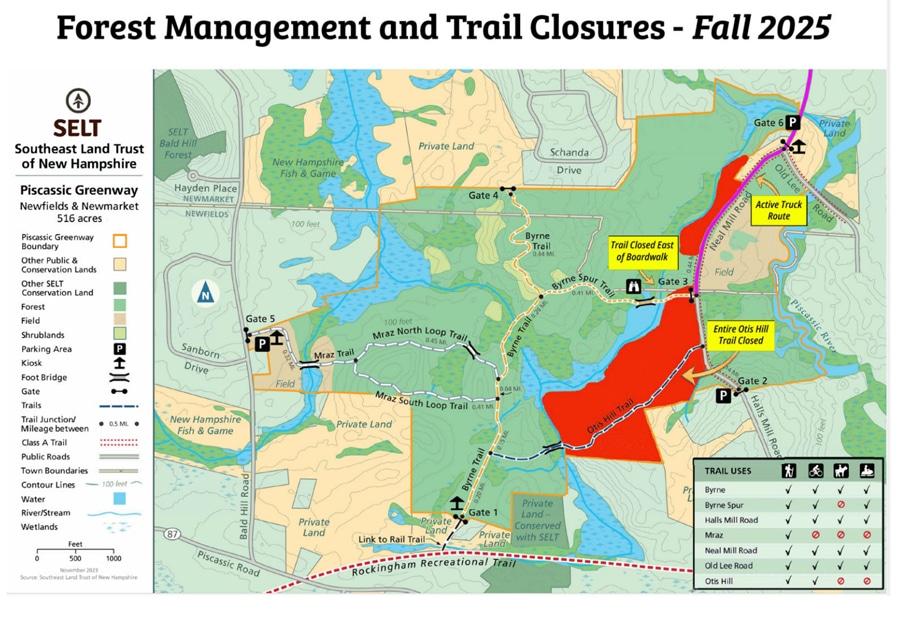
Located off of Halls Mill and Piscassic Roads in Newfields, and Schanda Drive in Newmarket, the Piscassic Greenway has frontage on the Piscassic River, a tributary of Great Bay. This property is also the crucial link between two blocks of existing protected lands that create a wildlife and recreational corridor of more than 2,000 acres from Newmarket to Exeter.
With its extensive network of trails and the adjacent Manchester-Portsmouth Rail Trail, the Piscassic Greenway is enjoyed by the public for outdoor recreation, including hiking, mountain biking, fishing, and hunting.
In 2005, the Piscassic Greenway as we know it almost became a 102 unit subdivision proposed as the Mill Woods Subdivision. Fortunately, the Trust for Public Land and then Rockingham Land Trust entered into an agreement with the developer, providing the Town with the chance to vote at Town Meeting on a substantial bond to make the project a reality.
Matching funds were raised from a variety of sources, including funds secured by US Senator Judd Gregg through the Coastal and Estuarine Land Conservation Program (CELCP).
Today, the Piscassic Greenway is a vital natural resource for the region. The Town of Newfields will hold a conservation easement over the entire property. The conservation easement assures the opportunity for continued recreational use of the property, while also making special provisions to protect water quality, wildlife habitat and ecologically sensitive areas.
SELT owns and manages the property and is planning trail improvements to protect wetlands and create sustainable access to the land.
Trail Guide and Map
(Mobile Friendly)
Trail Guide and Map
(Print and Fold)
Frequently Asked Questions About the Fall 2025 Piscassic Greenway Timber Harvest
What guides management activities on SELT lands?
Promoting regeneration means encouraging the growth of seedlings and saplings that are currently living close to the forest floor (also called the forest’s “understory”) and giving them the opportunity to become the next level in the forest canopy (the “overstory”). This careful, selective cut will provide ideal conditions for this to happen by allowing more light to pass through and by making growing space more available for the next generation of trees. A healthy, resilient forest is one that is diversified in many ways, including trees of a variety of ages, ranging from brand-new seedlings to centuries-old overstory trees.
What is the importance of forest regeneration?
Promoting regeneration means encouraging the growth of seedlings and saplings that are currently living close to the forest floor (also called the forest’s “understory”) and giving them the opportunity to become the next level in the forest canopy (the “overstory”). This careful, selective cut will provide ideal conditions for this to happen by allowing more light to pass through and by making growing space more available for the next generation of trees. A healthy, resilient forest is one that is diversified in many ways, including trees of a variety of ages, ranging from brand-new seedlings to centuries-old overstory trees.
Does SELT make money from timber harvests?
Yes – timber harvests produce revenue. The revenue from cuts will compensate the loggers, our consulting foresters, and pay appropriate town fees and taxes. SELT will receive revenue as well, which will be used to further our mission of saving, sharing, and stewarding the critical lands in our region.
This wood will be of good value for the regional economy, providing material for building supplies, firewood, and millwork. Finally, there is no financial quota for the cut; the ecological motivations are first and foremost and will guide the decisions on what to harvest or not.
How do harvests affect local wildlife?
The reality of any entry into the forest is that some wildlife may be temporarily impacted, but overall, harvests are designed to create a richer, more varied and healthier habitat for wildlife and plants. SELT consults with wildlife experts to ensure that operations are conducted in such a way that they have minimal negative impacts on wildlife and provides significant wildlife benefits.
Land management is always a balancing act and not every species may benefit, but the guiding principle of SELT’s ecological activities is to help as many native plants and wildlife flourish as possible, including any focal species known to be on a property. We do that by keeping the forest healthy and diverse so this beloved property can continue as a thriving forest for generations to come.