
Linh Aven and her husband Brian Fluharty are in year five of operating Dandelion Forest Farm, their beloved agroforestry enterprise in Nottingham. Born of a passion for sustainable crops yielded by natural, regenerative practices, the farming Linh and Brian pursue represents both a new and very old way of agriculture.
“I never set out to farm,” Linh says. “I was a scientist and a chef first, but I was becoming more aware of the state of our conventional agriculture and what that was doing to the land. So, I started learning about traditional, Indigenous regenerative farming practices and wondering why they weren’t more widely practiced.”
Leveraging her skills as a researcher, she dove into the concept of agroforestry, a systemic approach to farming that, as she says, “is the integration of annual crops, perennial crops, and animals.” Her epiphany came from a tree in Sicily. “Estimates are that this chestnut tree has been around for 2,000 to 4,000 years,” she says.
“It blew my mind. That one tree every year is producing so much wonderful food that falls to the ground. That was the kind of farming that I wanted to do.”
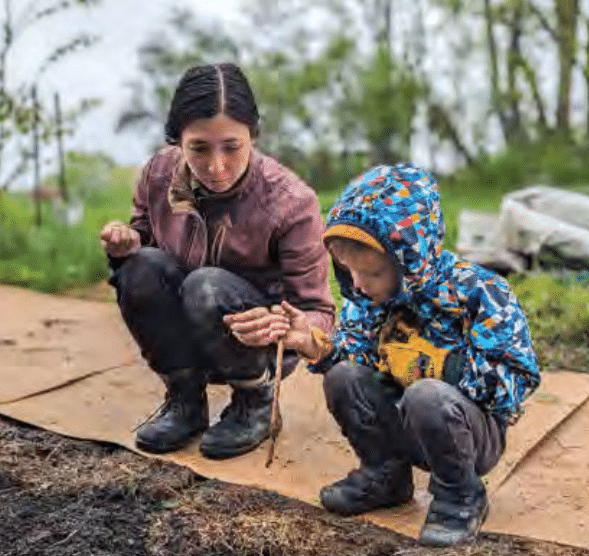
Her dream was realized when she and Brian were able to purchase Dandelion Forest Farm, an effort coordinated by SELT following the bargain sale of a conservation easement by the prior owners. Since then, Linh’s agroforestry journey has paid dividends; their trademark farm‑to‑table dinners are consistently sold out, and she has leveraged the New Hampshire turf in new ways, bringing unique flavors to the community sourced from an organic bounty that includes kale, elderberry, chestnuts, and much more (you should try the pine syrup and give your short stacks a kick).
Agroforestry isn’t anything new, of course. Indigenous communities that lived in the same areas for thousands of years cultivated an intricate knowledge of what the surrounding woods can provide. Centuries of experimentation, fine‑tuning, observation, and cultivation became a compendium of eco‑wisdom passed down from forebearers. Today, this approach to complex, system‑based agriculture is enjoying a resurgence.
According to a recent survey from the professional journal Agroforestry Systems, the number of farm operations with agroforestry increased by 6% nationally between 2017 and 2022. New Hampshire was the third‑ranked state in terms of highest percent increase of farms reporting at least one type of agroforestry.
SELT itself is poised to embark on its own agroforestry adventure in 2026 in partnership with the University of New Hampshire. Burley Farms, with its fields and forests punctuated by the 40+ acre beaver pond and its associated wetland systems, provides a diverse milieu where agroforestry could thrive. SELT was approached by the University of New Hampshire (UNH) to join the Adaptive Agroforestry Principles and Teaching (ADAPT) program. ADAPT’s goal is “to develop climate‑smart strategies for expanding New England agricultural production while supporting forests’ ecosystem services, farmers’ economic opportunities, and community health.” ADAPT is a collaboration between UNH, Dartmouth, and Yale.
“Burley Farms is an appealing site thanks to the favorable conditions that are relatively rare across SELT’s lands,” said Chad Fierros, SELT’s Forest and Wildlife Habitat Manager. “Our vision for agroforestry is to reestablish forest biodiversity and foster a connection to the land and model ways that other landowners can engage with the land.”
What does that mean in practice? There is the research angle, where SELT’s stewardship team can determine the specific practices that complement land management activities and encourage sustainability for crops like wild ginger, hazelnuts, pawpaws, Solomon’s seal, and bloodroot. And the practical side, where these plantings can become seed sources for future sites—and the community at large. ADAPT is working with twelve “Cooperators” across New England, which includes farmers, landowners, and land trusts who are cultivating agroforestry.
As a Cooperator, SELT will open its properties to researchers for field trials and studies. In addition, SELT will feed data to ADAPT to help fine‑tune and advance agroforestry, as well as offer its lands as a venue for field trips and educational demonstrations.
“SELT and UNH have enjoyed a mutually beneficial partnership for years, and we thought this would be a great way to continue that connection,” said Deborah Goard, SELT’s Stewardship and Land Engagement Director. “Agroforestry represents an exciting path for stewardship and sustainability, and in tandem with UNH, SELT can help determine how agroforestry could be used in our corner of New Hampshire as well as throughout New England.”
SELT’s agroforestry destiny intersects fully with that of farmers like Linh: to revitalize practices that sustained humans while benefiting local plant and animal communities for generations.
“We want our trees to also survive for thousands of years like that tree in Sicily,” Linh says. “What an unbelievable legacy that will be.”