
Thump.
It’s the queasy sound of a bird strike on a large window, the unfortunate byproduct of a grand view and regular applications of Windex.
When birds hurtle headlong into glass, it’s typically the result of two optical illusions that play havoc with their senses: transparency and reflection. The former creates a misleading thoroughfare, especially when windows sit across from each other, fooling the birds into thinking there’s a clear flight path before them. The latter tricks the birds, reflecting the surrounding sky and landscape and creating an illusion of a contiguous environment; birds just don’t possess the ability to discern the glass as a barrier.
According to the United States Geological Survey, up to two billion birds are killed each year in the United States due to collisions with glass. (www.usgs.gov/labs/bird-banding-laboratory/science/bird-window-collisions)
The SELT offices are not immune. The Nan and George Mathey Center for People and Nature was designed to present a panoramic view of the beauty of Burley Farms. The larger windows in the Pratt Family Community Room in particular had been installed to showcase the surrounding conserved land.
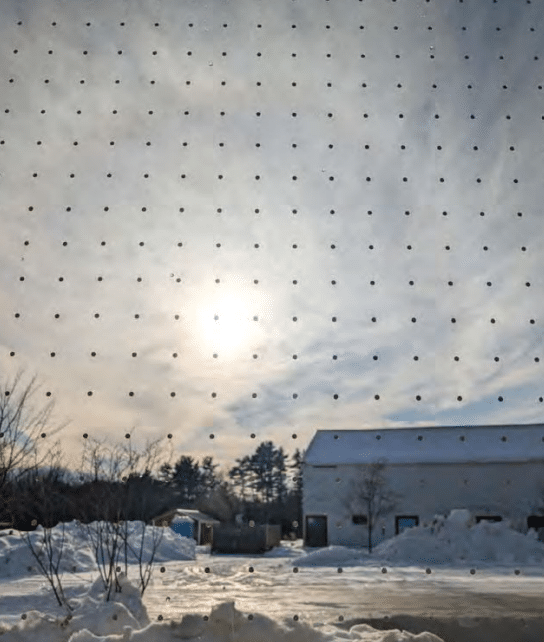
Sporadic bird strikes since occupancy in 2022, however, prompted action on finding a way to offset those optical illusions that lead to avian collisions. In the short term, SELT lowered the blinds on problematic windows, eliminating the risk and the view. Inspired to help solve this problem, long‑time member and passionate birder Patience Chamberlin offered to fund enhancements to the Mathey Center to solve the bird strike problem.
Her generous donation made it possible to purchase a sophisticated film manufactured by Feather Friendly. This film is adhered to windows and, after removal, leaves just a pattern of dots under 2” apart in all directions. This pattern and spacing are shown to greatly reduce bird strikes, informed by an analysis by the American Bird Conservancy.
In 2010, the Conservancy, in collaboration with architects, developed the Threat Factor (TF) measurement, which charts the effectiveness of materials in repelling bird strikes. The TF scale is 1–100, and the lower the TF score the better.
After reviewing three different products, SELT weighed the pros and cons and decided on Feather Friendly’s product (which has a great TF rating of 18). It offered the best balance of bird safety and maintaining views of Burley Farm—views that include northern harrier dive‑bombing rodents, a near‑daily event this past summer and fall. The installation was completed for the Pratt Community Room this past November, with another application scheduled for the spring for the large windows in our entryway.
Since then, the number of bird strikes has fallen to 0, helping SELT and the Mathey Center reduce the impact of the building on our feathered friends.
“We are so grateful to Patience,” said Brian Hart, SELT’s Executive Director. “Her love of birds, combined with a truly generous spirit, allowed us to both maintain the amazing views of the natural world that surround us while also protecting our friends in the skies.”
“I’m happy to help SELT and the Mathey Center set an example for other commercial buildings,” says Patience, “and hopefully inspire homeowners and businesses to use these products in their own spaces. Millions and millions of birds are killed due to window strikes each year in North America alone. With declining bird populations, we need to do everything possible to prevent window strikes, including in our own homes. Bird window treatments that are proven effective can keep birds from striking problem windows.”
While SELT had these products professionally installed due to the scope, size, and location of the windows, homeowners can install Feather Friendly or other products themselves. Patience’s advice: make sure the product is endorsed by the American Bird Conservancy, Audubon, or the Cornell Lab of Ornithology.
“We are so grateful to Patience for stepping up and helping us do this right and well,” said Brian Hart, SELT’s Executive Director. “Her love of birds, combined with a truly generous spirit, allowed us to both protect our friends in the skies while maintaining the Mathey Center’s amazing views of the natural world.”
Interested in learning more? Visit featherfriendly.com or abcbirds.org.