
New Hampshire’s State Wildlife Action Plan, produced by the NH Department of Fish and Game, provides a roadmap for conserving all wildlife in the state. Recently, the plan was updated, laying out new focus areas through 2035. SELT leans heavily on the Wildlife Action Plan to help guide its conservation priorities and land management strategies. “We use the plan often in our work,” says Chad Fierros, SELT’s Forest and Wildlife Habitat Manager. “We use guidance from the plan to inform our approach to habitat management and restoration. We use the conservation status of various species listed to help determine focal species for management.”
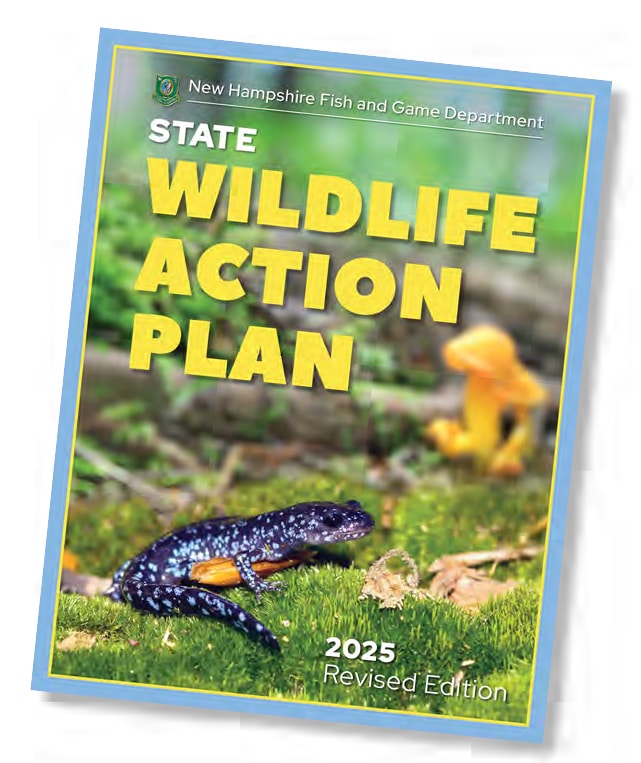
“For every land conservation project we consider, an evaluation of the habitat ranking under the Wildlife Action Plan is a critical factor in our decision making,” adds Duane Hyde, SELT’s Land Conservation Director. “In some cases, the ranking in the Wildlife Action Plan can be a pivotal tipping point in our decision making. We are looking forward to familiarizing ourselves more with the new updated plan so we can dig deeper into understanding why the habitat is ranked the way it is.”
We spoke with Michael Marchand, Nongame and Endangered Wildlife Program Supervisor, NH Fish and Game, to get his view of the updated plan and its importance for local conservation. The revised plan is available online at www.wildlife.nh.gov/wildlife-and-habitat/nh-state-wildlife-action-plan.
What are the big takeaways for the revised Wildlife Action Plan?
Reflecting on the last 10 years, I think we had a lot of successes and were able to implement a good percentage of the work that we had identified in the previous plan. So, great progress on species recovery, land protection, habitat management, and all those areas. We’ve also added 188 plant species to the plan, all of which have profiles, so that’s brand new. Also, a major focus is to bring in new partners to help us implement the plan. SELT and other land trusts have been critical partners since the start of the early Wildlife Action Plans. We can’t possibly do all the work ourselves, so we depend on long‑term partners like SELT.
Are there any updates for specific NH wildlife species?
Bald eagles continue to recover statewide and are no longer considered a rare species. Their population continues to expand, and it’s a great success story for the state and the country. We have added some shorebird species to the concern list, largely because of regional and global declines. Blanding’s turtle is a species that SELT has done a tremendous job helping to maintain. I know we worked with you on some turtle nesting habitat enhancement on some of your properties. The Blanding’s turtle’s survival depends on the conservation of large undeveloped blocks of land.
How about habitats and landscapes? Any new focus areas?
We definitely integrated marine and coastal habitats to a greater extent than we have in the past, breaking them up into in‑shore, near‑shore, and off‑shore. We divided the habitats to consider those species that are in deeper water versus closer to the shore. And we included marine fish for the first time.
This points to the importance of SELT’s focus on coastal watershed conservation efforts then?
Yes. Currently, there are a number of actions that are really important on the coast, whether it’s from a water quality perspective or just protection of land. Obviously, we’re not making more land, and so there are also some huge challenges associated with it in terms of opportunity. When you’re talking about species like Piping Plover on our sandy beaches, which are tremendously popular from a recreational perspective, there’s no place else for those species to go. The opportunities to enhance habitat are a lot more limited, so we have to work in partnership on the areas that we have.