
The Piscassic Greenway, Newfields. May 2025
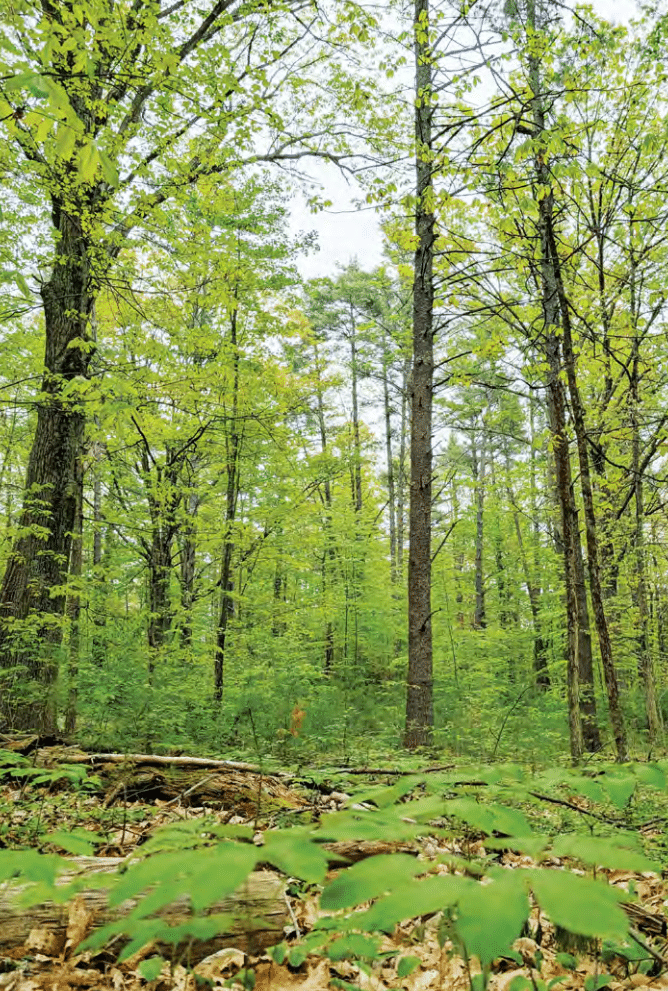
A brief walk from the Bald Hill Road parking area leads to part of the forest that, truthfully, if you didn’t know specifically what you were looking for you would likely keep walking by. For the majority of outdoor adventurers this section of the woods just rolls into the border topography – green, healthy, leafy, great.
And that’s the point. Chad Fierros, SELT’s Forest and Wildlife Habitat Manager, knows precisely what he is looking at, as he surveys the patch of green: a vision of intentional, science-based land management comes to fruition 14 years later.
“After SELT acquired the Piscassic Greenway,” Chad says, “one of our stewardship goals was to encourage forest health, productivity, and biological diversity within the forestlands of the property. In this case, that meant aiming to foster a spectrum of conditions that a good, healthy natural forest would exhibit.”
To accomplish this, SELT implemented a targeted timber harvest, with the goal of creating openings on the forest floor to encourage new growth and more desirable species of trees to create a durable, more resilient forest. This approach to meet the goal of maintaining healthy forestland was determined through the Piscassic Greenway’s management planning process, which involves thorough assessment of the land and collaboration among natural resource professionals.
“When you look at the mix in the Greenway landscape of agricultural land, wetlands, early successional woodlands, and then mature forest, it is just a very rich area,” says Phil Auger, a NH licensed forester and former Land Manager at SELT who oversaw the timber harvest 14 years ago. “Wildlife habitat is a high priority, especially for the Piscassic Greenway, which we know has resident wildlife that are quite rare.”
The past timber harvest approach was straightforward: identify the strongest trees to anchor the canopy but create enough space for sunlight to break through to feed the emerging understory. Looking at the results in 2025 reveals a fulfillment of that goal; saplings poke up across the forest floor and the forest structure contains a diverse mix of canopy trees, midstory trees, and a healthy understory.
“This opening was created to encourage young growth of desirable and resilient species,” Chad says. “Looking at this opening created by the timber harvest, I see we have some really nice red oak, white pine, red maple, and shagbark hickory. When it comes to forest management on SELT lands, this is the result we are aiming for – a forest with a diversity of tree species and ages, and different layers in the canopy. All together, these make the forest more resilient against current day threats such as invasive insects and climate change.”
The SELT Stewardship team is planning for additional forest management at the Piscassic Greenway with the same focus: to ensure a forest that supports a diversity of wildlife with promising young growth, large, mature trees, and a good mix of trees in between.
“We were dealt a decent hand as far as forest structure and diversity when we conserved the PIscassic Greenway,” Chad says. “For us we are maintaining and managing with a fairly light touch.”