
Written by David Johnson
Photographed by Jerry Monkman - EcoPhotography and David Johnson
The Largest Undeveloped, Privately-Owned Property in Portsmouth is a Conservation Miracle
If you weren’t looking for it, you would more than likely motor right past Joe Caveretta’s driveway. Especially if you’re beach-bound, heading east on Elwyn Road, waves and sand on the brain, the nondescript, unpaved entrance would barely be noticed.
Besides, what could possibly be down that road? A house, surrounded by more houses, which are likely surrounded by more houses? This is, after all, the New Hampshire Seacoast, one of the most desirable residential destinations in the Milky Way.
But, no, that’s not what lies beyond. In fact, after a half-mile of driving down the dirt road, flanked by thick forests, with all signs of dense suburbia ebbing away, an odd feeling may come across you. What is this place? Where am I?
Eventually a modest home and a sign of life will come into view but not before mild disorientation has set in. If it wasn’t for the occasional wisp of seabreeze that punctuates the wooded stillness, you’d think you had been teleported 200 miles northwest and deposited in the middle of the North Country.
Welcome to the 100-Acre Woods.
It was when Joe Cavaretta nearly died that he knew he needed to make a decision.
The year was 2007, and he had been admitted to the hospital with a mysterious heart malady that even baffled the doctor.
“He was really pessimistic,” Joe recalls. “I said, ‘I'm going to come home, aren't I?’ He replied, ‘Well, I hope so.’”
They never did figure out what the issue was - an unidentified virus of some sort was the leading candidate - but the experience left an indelible impact on Joe (“I really started to think about my own mortality,” he says).
At the center of that epiphany was the place he called home, his modest house sitting upon a staggering 100 acres of forest - the largest privately-owned, undeveloped, unconserved tract of land in Portsmouth. Unsurprisingly, this swath of prime real estate had been an object of desire for more than a few developers; a steady cascade of inquiry letters had filled Joe’s mailbox over the years. In 2012, there was a near-hit when a conversation with a developer had progressed beyond pleasantries, but the talks stalled.
It was right around this time that Joe began to have another discussion, this one focused on an alternative route from development. In the summer of 2012, Joe called SELT to inquire about a conservation easement.
A Family History
The Caveretta family has been a fixture in Portsmouth for generations. Joe’s parents owned the beloved Foye’s Corner Market, once located at the Route 1A roundabout (where the current Atlantic Grill sits), a regional nexus for decades, a place where you could grab a loaf of bread and the latest community scuttlebutt all in one visit. Joe grew up in that store, working from a young age and learning the nuances of the societal fabric through making change and sweeping floors (Keep an eye on those New Castle boys…Be there first thing in the morning to open the store for third shift sailors from the Navy Yard already waiting in line for their beer and cigarettes.)
Those Portsmouth roots dug deep, and he would eventually find himself attached even closer to the community when, as a 23-year-old fresh out of college, he moved onto his Uncle John’s property as a caretaker. John originally bought the parcel in 1949, and eventually opened a game farm on it, supplying many local restaurants with quail, pheasant, and other game birds.
“I was just out of college,” Joe recalls, “just started in masonry, and moved there all at the same time. It was a big change of life.”
Thankfully, the transition wasn’t completely alien. He had been coming to the woods for years, helping his father and uncle cut wood or running chores on behalf of the game birds. Other family members had balked at the thought of moving on to the property because of its isolation, but Joe didn’t mind.
He was, after all, just starting out on a post-graduate life and his career was nascent enough that options to purchase elsewhere were limited, and for someone interested in accumulating DIY skills, there was no better learning annex to be found (“I basically learned how to do a lot of little home repairs, like solder pipes and fix wiring because I had no money to call a contractor,” he says.)
Little did he know at the time these early life decisions would yield a conservation opportunity with staggering implications over 40 years later.
A Community Gem
Joe’s property is more than a real estate oddity. Sure, an untouched chunk of Portsmouth land this size is rarer than a sighting of Bigfoot reading a Gutenberg Bible, but scarcity doesn’t begin to encapsulate the value proposition of the 100-Acre Woods.
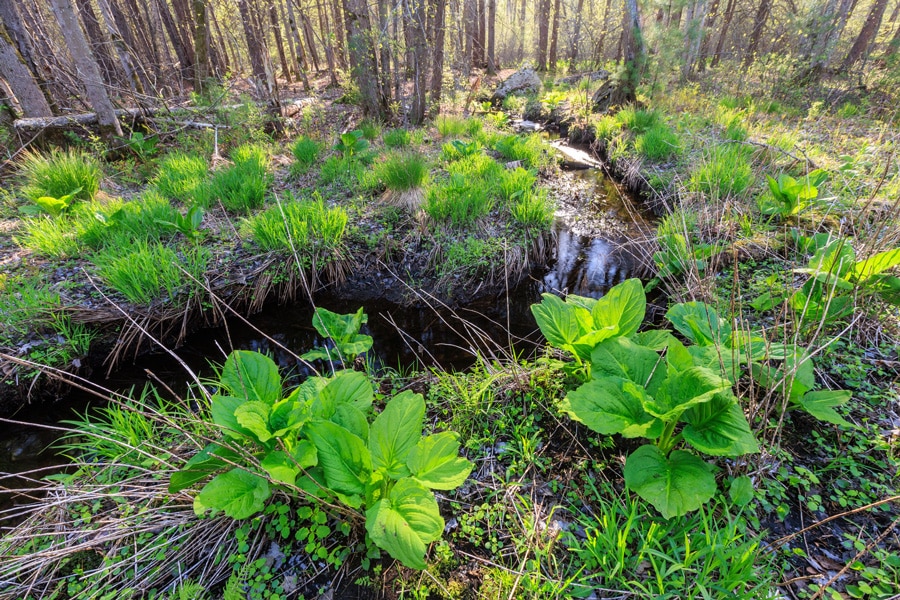
For the City of Portsmouth, this land was a top priority, informed by its 2020 Open Space Plan, and supported by multiple other science-based, data-driven conservation plans on the regional and state level. It is rife with natural resources, including habitat and transit corridors for common and threatened wildlife, protection for the water quality of Berry’s Brook, and wetlands that repel flooding and capture pollutants.
“The 100-Acre Woods is an identified top priority for conservation under the City’s Open Space Plan,” said Samantha Collins, Chair of the Portsmouth Conservation Commission. “After walking the property and seeing first-hand its significance and quality, the Commission knew it was worth permanently protecting and partnering with SELT to acquire a conservation easement."
Beyond the cache of nature-centric treasure, the 100-Acre Woods presents a compelling option for future community use. Dispersed public access is a requirement for LCHIP funding (one of the grant sources to complete the acquisition of the conservation easement), and with the land’s proximity to two public schools - Portsmouth’s Dondero Elementary School and Rye Elementary School - the potential for outdoor education and recreation is real and tantalizing.
“After walking the property and seeing first-hand its significance and quality, the Commission knew it was worth permanently protecting."
On September 3, 2024, the Portsmouth City Council unanimously approved the Conservation Commission’s recommendation to contribute up to $1 million from the City’s conservation fund to support the 100-Acre Woods project. In addition, LCHIP also provided funding for the project along with Great Bay 2030 .
“We are watching Mr. Cavaretta make a different choice for Portsmouth,” said Portsmouth Mayor Deaglan McEachern. “It’s fantastic that he’s doing it, and it’s fantastic that SELT has built up the trust with Mr. Cavaretta.”
Said longtime Portsmouth resident and retired attorney Peter Loughlin: “We are at one of those very rare moments in the modern history of Portsmouth where we have a landowner interested in protecting land forever and is willing to make an incredibly generous financial contribution to promote the public good.”
In 2025, this moment was made real when SELT completed the conservation of The 100-Acre Woods.
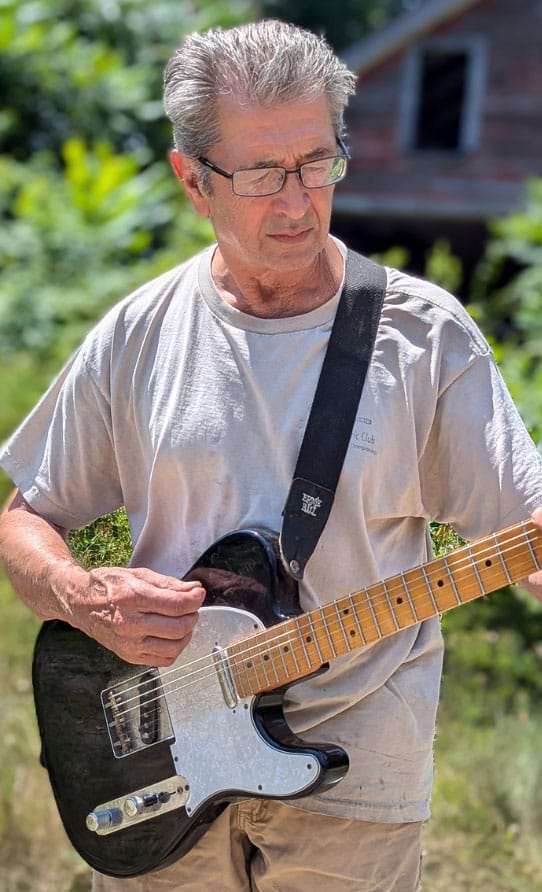 There’s a guitar sitting on Joe’s kitchen table, a Fender Stratocaster. Next to it lies a collection of tools, most of which could pass for fine surgical instruments.
Repairing and tuning electric guitars is Joe’s go-to-hobby (especially since the cardiac event disqualified his more athletic pastime of tennis). Joe has always been compelled by pursuits that blend art with craft, which is what drew him to masonry in the first place; a chimney has to function properly of course, but there is a creative flair that goes into the stonework, which makes every one of his creations unique. The same applies for guitars: there is science, but you don’t really know if the strings will sing until a musician actually plays it.
Joe unhooks the clamps, picks up the guitar, and takes it outside. He sits in front of the old barn that he used to work in as a child. The sun is out and there is a faint smell of salt in the coastal wind as it blows through the trees. He strums a few chords. He pauses, crooks his head, tightens a string, and plays again.
There is still work to do - but it feels right and is sounding better by the day.