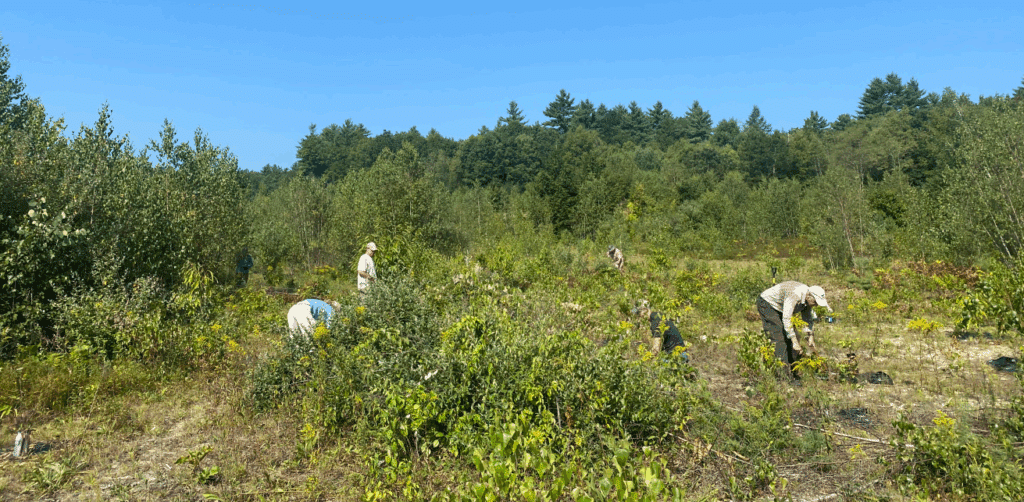
Recently, a handful of volunteers and SELT staff ventured out to Two Rivers Preserve in Epping to check up on some very special guests. It was time to see how the American Chestnuts were doing.
Planted several years ago, these trees represented an important ecological conceit: hope. The hope that the American Chestnut, nearly wiped off the face of the map from blight, can make a stunning comeback. The forestry equivalent of 28-3.
In May, 2021 SELT volunteers planted a series of American chestnut saplings in a section of land that was selected due to its soil makeup and sun and shade mix. This project came from the American Chestnut Foundation, who strove to create observable “micro-forests” in different settings. The purpose: to gather data on ideal planting locations, which will later be used in procedures to breed a new generation of chestnuts that could withstand chestnut blight, the fungus that decimated the American Chestnut population.
“Our folks came out today, over four years later, to keep up with it, make sure everything looks good,” said Chad Fierros, SELT’s Forest and Wildlife Habitat Manager.
In addition to performing a check-up, the crew planted six new seedlings, replacing a few that hadn’t made it, weeded around the trunks, cut back interloping invasives, and charted the the height of the trees.
The verdict?
“A lot of them were looking really good,” Chad says. “They have a range of growth, with some around 10 feet tall and some not as tall but with got green leaves, so they’re alive.”
This comeback will not be overnight; indeed, the return of the American Chestnuts represents a long game. As in it will be a couple of decades before the Two Rivers batch begins to – hopefully – create more American Chestnuts and truly reclaim their crown as one of the most important and conic tree species in the forest.
“The American Chestnuts are an important species of the landscape,” Chad says. “The are the native species of our region and encouraging return is another management activity that can support resilient forests in the area.”